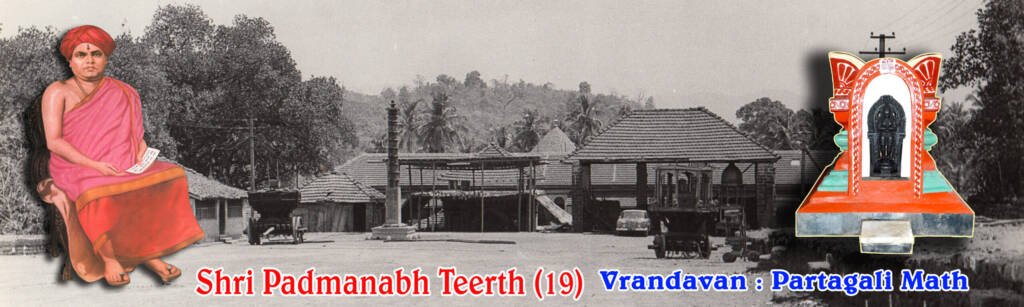
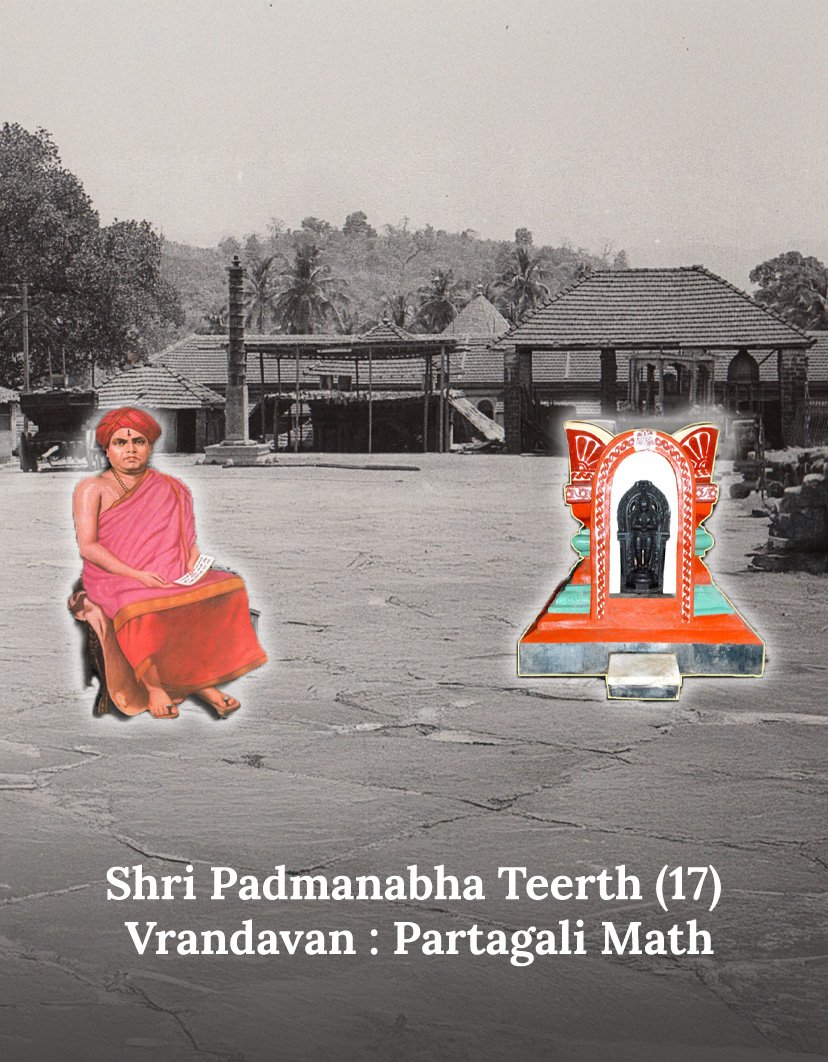
Shreemad Padmanabha Teerth
Birth Place : Honnavar
Birth Name : Narayan Venkatesh Bhatta
Birth Date : Saka 1750 Sarvadhari Samvatsara Shravana Shukla Dvitiya, Tuesday (12/08/1828)
Sannyasa Deeksha : Saka 1761 Vikari Samvatsara Magha Shukla Panchami, Saturday (08/02/1840) at Shri Jivottama Matha, Gokarna
Guru : Shreemad Poornaprajna Teerth (18)
Accession : Saka 1801 Pramadi Samvatsara Jyeshtha Shukla Chaturdashi, Tuesday (03/06/1879)
Shishya : Shreemad Indirakanta Teerth (20)
Mahanirvan : Saka 1814 Nandan Samvatsara Ashadha Shukla Saptami (01/07/1892)
Vrundanva : Partagali Matha
Period as Shishya : 39 years 03 months 26 days
Period as Guru : 13 years 00 months 29 days
Period in service of matha : 52 years 04 months 24 days
History of Swamiji
न्यायव्याकरणभिज्ञं मध्वसिद्धान्ततत्परम् ।
पद्मनाभगुरुं वन्दे मध्वसिद्धान्तलब्धये ॥
- Born in Honnavar in Saka 1750 on Shravan Shukla Dvitiya.
- Initiated into Sannyasa and ordained Shri Padmanabha Teerth by Guru Shri Poornaprajna Teerth on Magha Shukla Panchami of Saka 1761 Vikari Samvatsara.
- The Guru-Shishya pair worked in complete unison, ensuring smooth administration of the matha.
- The shishya earned the complete trust and blessings of the Guru.
- Revered Yatishwaras in the lineage of Shree Samsthana Gokarna Partagali Jeevottama Math worked tirelessly for cultural and religious endeavors.
- Shri Padmanabha Teerth and Shri Kamalanatha Teerth are notable examples who briefly adorned the seat of the Math.
- Guru Shri Poornaprajna Teerth was a towering scholar in Vedas, Vedangas, Vedanta, and Shree Madhva philosophy.
- Shri Padmanabha Teerth provided a supportive environment for the propagation of dharma, public awareness, and social work.
- Shri Padmanabha Teerth led the Matha as its head for thirteen years during Portuguese religious persecution.
- He boldly resisted the Portuguese regime and reclaimed the full rights and ownership of the Shri Matha.
- Shri Padmanabha Teerth was born as Shri Narayana Bhat in Shaka 1752.
- Initiated into monastic life by Shri Poornaprajna Teerth after examining his horoscope and signs.
- Shri Poornaprajna Teerth taught various disciplines to Shri Padmanabha Teerth.
- Guru and disciple traveled to prominent pilgrimage centers for the propagation of dharma and public awakening.
- Shri Padmanabha Teerth focused on the safety and administration of the main Matha and its branches.
- Guru Shri Poornaprajna Teerth entered Vrindavana on Jyestha Shukla Dvitiiya, Shaka 1801.
- Shri Padmanabha Teerth assumed the role of the pontiff after the Guru Peetha ascension ceremony.
- Confronted anti-Hindu aggression with unshakable wisdom and inner strength.
- The victory in the struggle against Portuguese forces remains a golden chapter in the history of Shri Matha.
- The fragmentation of society under British and Portuguese rule had a deep impact.
- Portuguese rulers devised a conspiracy to destroy the influence and presence of the Matha.
- The Portuguese regime in Goa:
- Demolished Hindu temples and mathas.
- Looted movable property.
- Seized immovable assets.
- Those who refused to convert to Christianity or bow down to their rule were forced to flee Goa.
- The survival of the Hindu religion was threatened under Portuguese oppression.
- Many Hindus, including people from Shri Padmanabha Teerth’s community, lived in fear and resignation.
- Well-wishers and community members advised Shri Padmanabha Teerth to abandon efforts to retain control over the Matha’s properties.
- Shri Padmanabha Teerth stood firm with a handful of loyal followers and continued the struggle with courage and conviction.
- On May 7, 1852, the Portuguese government appointed a committee to oversee the properties of the Shri Samsthan Partagali Jeevottama Matha, with all members being Hindus.
- The Portuguese strategy was to pretend neutrality while intending to seize control of the Matha’s rights and properties.
- Shri Padmanabha Teerth had foreseen this move and warned the likely appointees, leading to the first committee remaining inactive for nearly a year.
- The Portuguese government claimed there was no connection between the Shri Matha and Shri Padmanabha Swamiji, dissolving the first committee and appointing a new one on April 22, 1853.
- Certain manipulative elements from within the community were suspected to be involved in the appointment of the second committee.
- Shri Padmanabha Teerth intensified his resistance and presented a logical and principled argument to the government about the role of the Gurupeetha.
- The Portuguese government ignored all appeals and issued a fresh order on May 31, 1856, constituting a third committee.
- Shri Padmanabha Teerth compiled a detailed record of the Matha’s functions and activities and submitted it to the Portuguese government.
- He convened a grand public assembly (Mahasabha) in Partagali to rally the Goud Saraswat community.
- The purpose of the Mahasabha was to awaken the community’s conscience and inspire it to fight for the survival of the Matha.
- In the grand assembly, Shri Padmanabha Teerth reminded everyone of the selfless work of the great ascetics following the tradition of the Matha.
- The foundation for the community’s identity and prosperity was the mediation of the Guru Matha, the wisdom of the gurus, and their power of penance.
- The community was to decide whether the divine center was still necessary for society.
- If the Portuguese government interfered with the Matha, it would be necessary to leave the Partagali Matha in Goa and take residence in the Swamatha Matha at Gokarna.
- The Gurus assured the community that they would not retreat in the religious battle and would continue their efforts until victory and prosperity were attained.
- ned
- . Shree Padmanabha Teerth’s words inspired the community, likening him to the fiery spirit of Lord Parashurama
- Community representatives, ashamed of their earlier passivity, pledged full support to their Gurupeetha
- The grand assembly led by Shree Padmanabha Teerth inspired people to actively work for the preservation of the matha
- Questions arose regarding the administration and control of temple properties, leading to mistrust within the community
- Shree Padmanabha Teerth foresaw the possibility of shifting the matha’s center but recognized the adverse consequences
- Swamiji continued the struggle on two fronts: peaceful legal fight and social awakening.
- The Portuguese government failed to control the matha despite appointing three committees.
- The Portuguese influence caused a decline in the matha’s income, and Swamiji submitted evidence to the Portuguese governor.
- On 13th December 1859, the Portuguese Governor-General handed over complete authority of Shri Matha to Shree Padmanabha Teerth.
- Shree Padmanabha Teerth demonstrated that organized community strength and divine power can subdue even the most cruel forces.
- In 1880, a new law applicable to Hindu temples threatened the matha’s autonomy.
- Shree Padmanabha Teerth presented strong evidence and drafted regulations asserting the matha’s autonomy.
- On 6th July 1881, the Governor-General upheld the matha’s autonomy.
- The Portuguese central authority confirmed the Governor-General’s order, granting the matha complete autonomy.
- The order was officially published in the Government Gazette of Goa on 17th September 1883.
- Shree Padmanabha Teerth’s relentless struggle ensured the matha’s secure foundation and victory.
- The Gokarna Partagali Jeevottama Matha and the Kashi Matha strive to nurture love and harmony between them.
- Guru Shree Poornaprajna Teerth’s working style involved continuous movement in society and providing guidance.
- Shree Padmanabha Teerth ensured the proper use of funds and successful completion of projects.
- In 1852, Shree Poornaprajna Teerth traveled to Kashi and resolved to conduct regular Brahmin feeding at the original matha.
- The king of Kashi deposited a principal amount of 6000 rupees, and the interest was used for the daily food donation.
- Shree Padmanabha Teerth actively collected detailed reports about community institutions to prevent neglect and ensure goals were met.
- When the king of Kashi neglected the food donation, Shree Padmanabha Teerth corresponded with him, reminding him of the principal amount and insisting on the continuation of the daily feeding.
- After two years of no response, representatives were sent to Kashi, and the principal amount was eventually recovered during the time of Shree Indirakanta Teerth.
- Shree Padmanabha Teerth entered the ashram at nine years old and received training under Shree Poornaprajna Teerth.
- He was learned, detached, disciplined, and ensured daily tasks were completed on time.
- Shree Padmanabha Teerth provided financial help to temples, mathas, and institutions in need.
- He arranged for local wealthy patrons to donate fixed assets like land and gardens for maintenance.
- During his time, the Ramadevaru temple tower of the Partagali Math received a copper plate inscription.
- Neglected fields and lands in Goa were planted with coconut, mango, and jackfruit trees, and a large lake was constructed for irrigation.
- A guesthouse was built for visitors and pilgrims, and a neglected piece of land called Inamagal was developed for agriculture 8.
- To accommodate growing numbers of visitors, a large kitchen and dining hall were constructed at the main matha.
- New puja materials, ornate umbrellas, and decorations were arranged for the deities Ramadeva and Veera Viththal.
- Small and long pilgrimages were undertaken to places like Tirupati, Vishnukanchi, Madurai, and Rameshwaram.
- At Rameshwaram, a Vigraha (idol) of Mukhyaprana was installed.
- The Chaturmas vrata was observed in various places.
- On Vaishakha Shukla Dashami day in Shaka 1808, Ramakrishna, later known as Shreemat Indirakanta Teerth, was initiated into Sannyasa.
- Shree Indirakanta Teerth became a great ascetic and sage, elevating the glory of the math.
- He appointed a renowned scholar to teach disciples.
- Shree Indirakanta Teerth had six years of close association with his guru and was appointed as the successor of the matha.
- On Ashadha Shukla Saptami day in Shaka 1814, Shree Padmanabha Teerth entered the Partagali matha’s Vrindavana.
Most of the correspondences and documents available today in the matha’s office from the period of Shri Padmanabha Teerth are transactional records about finances & land holdings, ownership documents used in court, etc. Shri Padmanabha Teerth earned several new land holdings for the matha & increased its overall revenue collection.