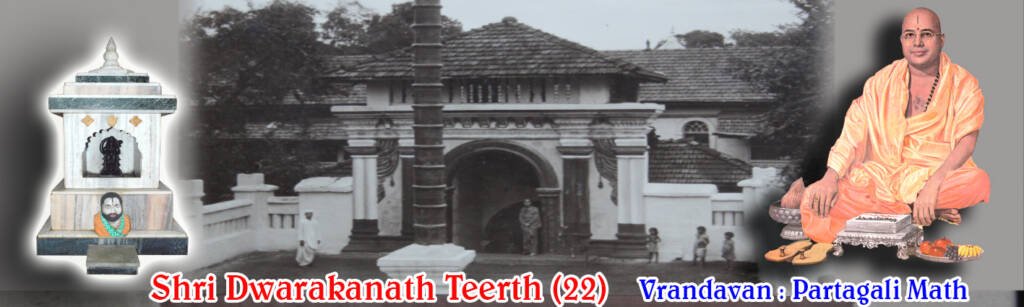
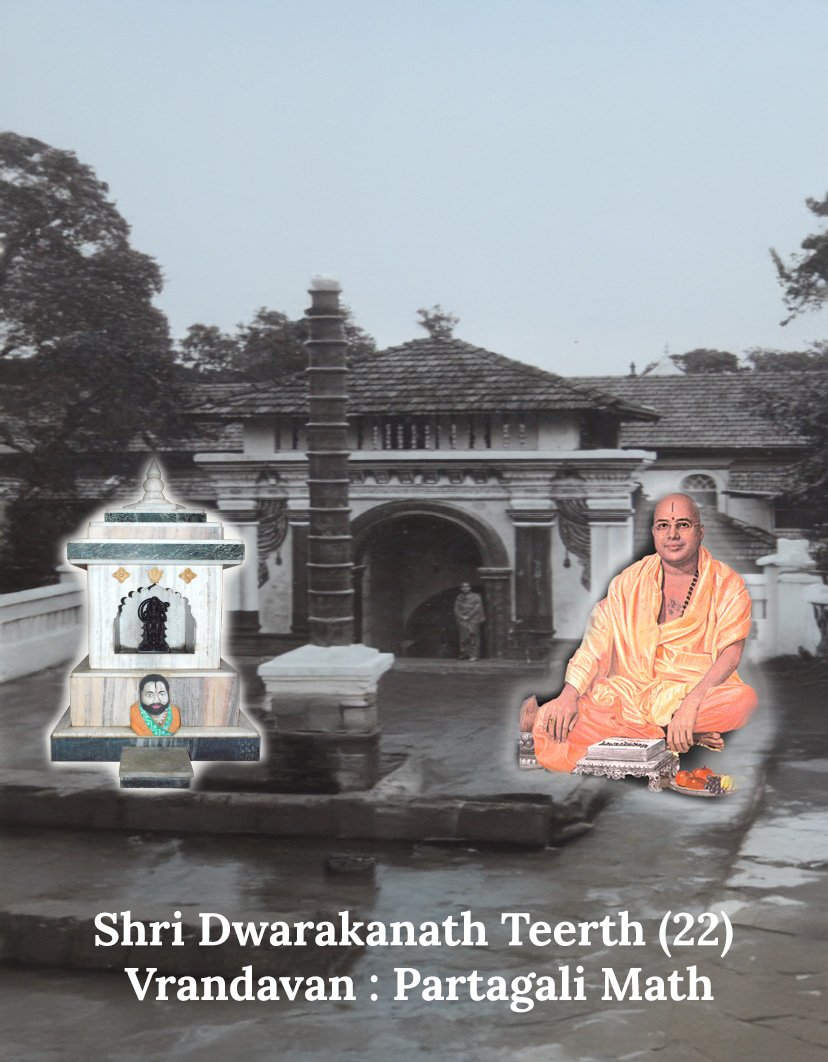
Shreemad Dwarakanath Teerth
Birth place : Gangolli (Udupi District)
Name at Birth : Govind Ramanath Acharya
Birth date : Saka 1841 Siddhartha Samvatsara Jyeshtha Krushna Ashtami, Saturday (21/06/1919)
Sannyasa Deeksha : Saka 1864 Chitrabhanu Samvatsara Vaishakh Krushna Ashtami, Thursday (07/05/1942)
Place of Deeksha : Partagali Matha
Deeksha Guru : Shreemad Kamalanatha Teerth (21)
Accension : Saka 1865 Subhanu Samvatsara Chaitra Krushna Ashtami, Tuesday (27/04/1943)
Shishya Sweekar : Shreemad Vidyadhiraj Teerth (23)
Mahanirvan : Saka 1894 Paridhavi Samvatsara Phalgun Krushna Shashthi, Sunday (25/03/1973)
Vrundavana : Partagali Matha
Period as Shishya : 00 years 11 months 20 days
Period as Guru : 29 years 10 months 26 days
Period of service to Matha : 30 years 10 months 18 days
Age : 53 years 09 months 04 days
Matha Construction :
1) Mallyar Matha Gangolli (Handover) 16/03/1945
2) Shree Ram Mandir Wadala, Mumbai 07/02/1965
3) Shree Dwarakanath Bhavan, Bengaluru, 24/09/1957
4) Shree Indirakanta Teerth Bhavan, Vasco 15/05/1963
History of Swamiji
कमलानाथदोर्जातं विद्यार्थि गणसेवितम् ।
वन्दे सुहास्यवदनं द्वारकानाथ योगिनम् ॥
- Shreemad Dwarakanath Teerth Swamiji was born in Gangolli Village, Udupi District.
- The village is home to the renowned ‘Senapur Acharya’ family of pundits.
- Saraswat Brahmana Divan Narayan Mahale constructed the Gangolli Venkatramana Temple and appointed the family for worship.
- The temple was handed over to the Gokarna-Partagali-Jeevottama Matha during Shreemad Dwarakanath Teerth’s reign.
- Born in this family, the son of Vidvan Vaidika Ramnathacharya and Bhavanibai became the 22nd pontiff of the Gokarna-Partagali-Jeevottama Matha, Shreemad Dwarakanath Teerth.
- He was born in Saka year 1842 and named Govind Acharya.
- After primary education in Kannada and English, he turned to Sanskrit education.
- He received early training in vaidika rituals from his father.
- To further his Sanskrit education, he studied at Shree Bhuvanendra Sanskrit College in Karkala and then at Partagali Matha under Shreemad Indirakanta Teerth.
- He studied vedas, vedangas, nyaya, mimamsa, etc., under Shree Indirakanta Teerth and Shree Kamanatha Teerth.
- Shree Indirakanta Teerth identified his potential and chose him as his prashishya.
- On Vaishakh Vadya Saptami of Saka 1864 (07/05/1942), Shree Kamalanatha Teerth initiated him into Sannyasa and ordained him ‘Shree Dwarakanath Teerth’.
- He acceded to the Gurupitha on Chaitra Vadya Ashtami of Saka 1865 Subhanu Samvatsara (27/04/1943).
- His reign from Saka 1865 to Saka 1894 was marked by a settled socio-religious situation.
- Religious restrictions, rites, and duties had begun to be forgotten, but the religious fervour of Vaishnavas and Saraswatas persisted.
- Shreemad Dwarakanath Teerth garnered respect and support for his erudition, scholarship, and benevolence.
- He took active efforts to ensure no intellectual rift arose between society and the religious institution.
- His policies benefited both his matha’s disciples and society as a whole.
- Swamiji was a visionary and planned various initiatives such as setting up Sanskrit Pathshalas, high schools, colleges, publishing houses, and renovating and constructing mathas.
- Despite poor health, he travelled widely to bring his plans into action and raised funds for his initiatives.
- He faced unstable political situations with a composed mind and worked for the best interests of the matha.
- He worked towards unifying diverse Hindu sects for larger interests.
- He continued the policy of amicable relations between the Gokarna and Kashi mathas.
- He held talks with mathadhipatis of various mathas for Hindu social awakening and unification.
- He participated in the Madhva Philosophy Conference and the World Religious Conference in Mumbai.
- He delivered a landmark speech on the necessity of religion for social well-being.
- He established three new mathas in Maharashtra, Goa, and Karnataka.
- Constructing the matha in Mumbai required nearly ₹1.5 million and was a major challenge.
- Swamiji first came to Mumbai in 1950 for sanchara and treatment of spinal injuries.
- He proposed the construction of a matha in Mumbai and called a meeting of prominent followers.
- The construction committee was established, and the matha was built in Wadala.
- The matha in Mumbai was inaugurated on Magha Shuddha Navami of Saka 1876 (2nd February 1955).
- Swamiji set up an education committee and organized cultural programs to fund educational activities.
- The construction of the matha in Mumbai was completed over the next 5 to 6 years.
- He also worked towards building a matha in Bengaluru and acquired land in Basavanagudi.
- Swamiji oversaw the renovation of Partagli matha and performed punahpratishtha of the idols of Rama, Sita, and Lakshmana on Magha Shuddha Panchami of Saka 1887 Vishvavasu Samvatsara (5th February 1966).
- Swamiji’s reign of roughly 3 decades was peaceful socio-culturally but tumultuous politically.
- The Gokarna-Partagali Jeevottama Matha faced challenges due to frequent wars, India’s independence, Goan liberation struggle, troubled Indo-Portuguese relations, and embargoes.
- Many properties and followers of the Matha were outside Portuguese Goa, making management difficult.
- Swamiji efficiently managed matha affairs without compromising the institution’s interests.
- In 1953, Portuguese Minister for Overseas, Manuel Maria Sarmento Rodrigues, visited Goa and met Swamiji.
- A decreto was issued on 23rd January 1954 exempting import duties on idols and worship articles for Gokarna and Kavale mathas.
- In March 1973, Swamiji toured the Canara district of Karnataka and visited Dharmasthala on 25th March despite high blood pressure.
- Swamiji fainted and passed away on 26th March 1973 at 10:25 am while preparing to leave for Partagali.
- News of Swamiji’s passing spread quickly, and thousands of devotees from Goa and Karnataka rushed to Ankola.
- Shishya Swamiji Shree Vidyadhiraja Teerth decided Swamiji’s vrundavana should be constructed at Partagali.
- Swamiji’s mortal remains were taken to Partagali, where countless devotees paid their respects.
- Swamiji’s popularity and social acceptance led to non-Saraswata traders closing their shops and offices in grief.
- The Government of Goa, Daman, and Diu’s parliamentary session observed 2 minutes of silence in respect for Swamiji.